SIGGRAPH Asia 2026 / Birds of a Feather
Syn-Life Arts When engineered life enters interactive art
An open facilitated discussion for artists, researchers, designers, and technologists working across biology, AI, graphics, and interaction.
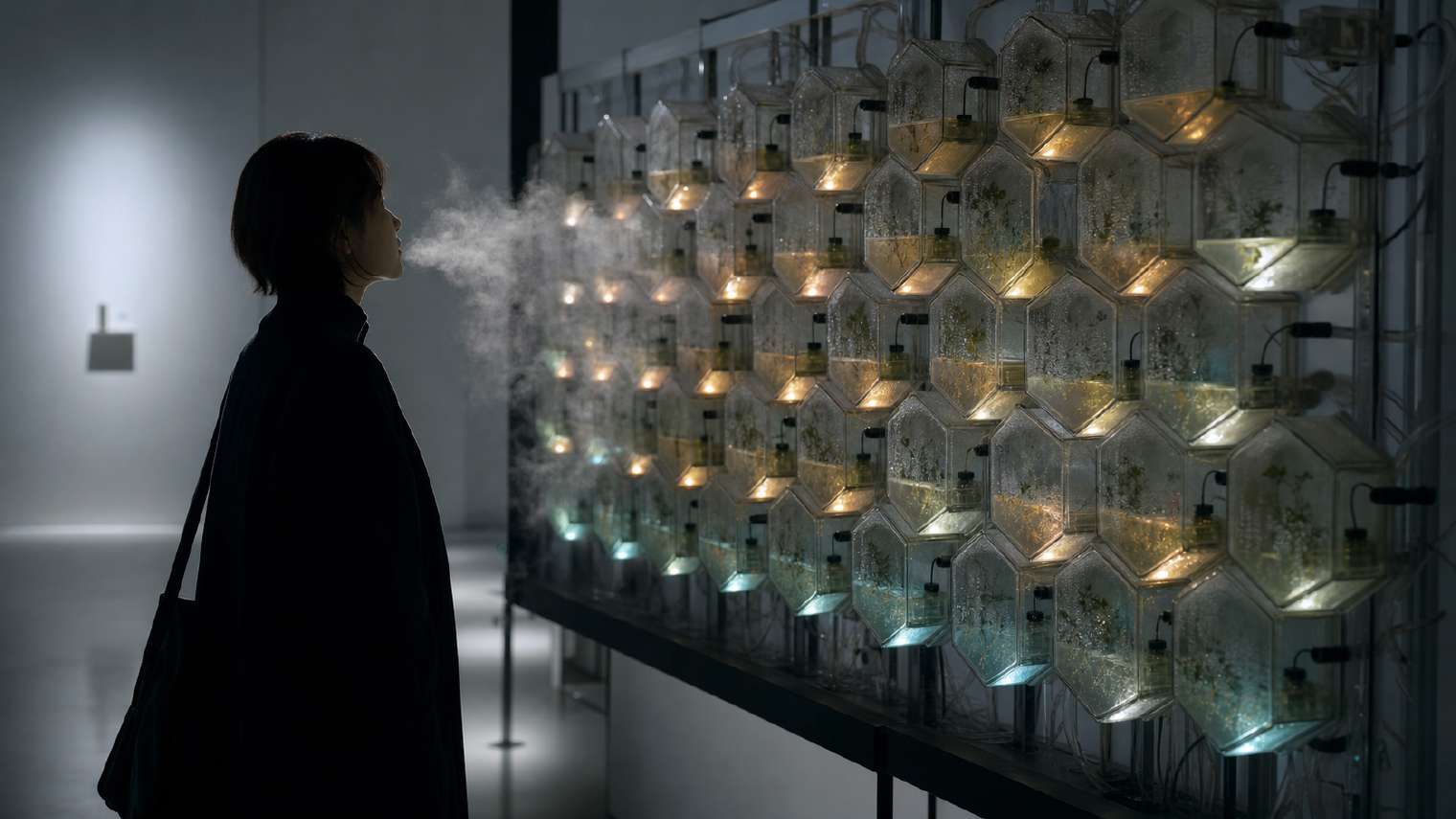
See how the session worksArtificial Hive / residency concept study
What is Syn-Life Arts?
Art shaped by the behavior of living systems.
Syn-Life Arts is a developing field for artworks shaped by engineered living systems.
Cells, microorganisms, biomaterials, and DNA can influence a work's timing, form, and outcome. Their behavior becomes part of the artistic process.
The field brings artists, scientists, institutions, and publics into shared questions of perception, interface design, care, interpretation, and closure.
Why SIGGRAPH
Living processes reach the public through computational media.
Cameras, sensors, models, images, sound, and spatial interfaces shape what people can perceive and how they understand a living system.
The SIGGRAPH community builds many of these tools. Syn-Life Arts places them inside a wider discussion about biological agency, public experience, and responsibility.
- 01
Graphics and visualization
Render growth, change, and biological signals across time.
- 02
Interaction and sensing
Design exchanges among bodies, organisms, instruments, and spaces.
- 03
AI and computation
Model living behavior and examine how computational choices shape interpretation.
- 04
Art and public culture
Give technical decisions a form that people can experience and discuss.
Who should join
A room for people working across disciplines.
The session welcomes people who make, study, interpret, or care for living and responsive systems.
-
Artists and designers
Media art, performance, sound, speculative design, materials, writing, and curatorial practice.
-
Graphics and interaction
Computer graphics, visualization, HCI, XR, sensing, robotics, and embodied systems.
-
Biology and engineering
Synthetic biology, biomaterials, ecology, biomanufacturing, AI for biology, and laboratory research.
-
Culture and education
Curators, educators, anthropologists, ethicists, producers, and public-program makers.
Bring a question, a method, a difficult case, or a project in progress. Participants at every level of biological experience are welcome.
How the session works
A facilitated discussion built around the room.
The organizer provides a short frame. The participants supply the cases, questions, and points of tension.
- 01
Opening frame
Baoyang Chen introduces a working definition of Syn-Life Arts and the questions behind the session.
- 02
Map the room
Participants briefly locate their practice, interest, or experience within the topic.
- 03
Guided discussion
The room works through selected prompts, with space for examples, disagreements, and emerging terms.
- 04
Shared synthesis
We gather useful language, unresolved questions, and possible connections for work after the conference.
Questions for the room
What changes when living matter participates?
These prompts open the conversation. The room can reshape them as new concerns emerge.
- 01
When does living matter become a participant in an artwork?
- 02
How can graphics and interfaces translate living processes while preserving biological tempo?
- 03
What do sensors, models, images, and sound reveal or leave out?
- 04
How do maintenance, uncertainty, and failure shape authorship?
- 05
How can public experience inform technical decisions while they remain open?
What we hope to build
A vocabulary that can travel beyond the room.
- 01
Working vocabulary
Terms that help different disciplines speak precisely about living systems in art.
- 02
Open question map
A clearer view of the artistic, technical, and ethical questions that still need work.
- 03
Continuing connections
People and practices that can carry the conversation into research, teaching, and future collaborations.
Practice context
The discussion grows from work inside research environments.
The international Syn-Life Arts residency at SIAT gives the conversation a practical starting point. The BoF remains centered on the experience and questions participants bring into the room.
Organizer and facilitator
Baoyang Chen
Executive Director
Cross-Media Lab
Shenzhen Institute of Advanced Technology, Chinese Academy of Sciences
Convening the discussion on behalf of Cross-Media Lab.
hello@synlife.art